kumiko.rocks beta

Features

Kumiko Features: built for compliance, built for speed

Multi-tenancy, audit trail, encryption — as the foundation, not an add-on. Every feature with its business value AND its technical approach, for decision-makers and engineers on one page.

Kumiko is pre-1.0 — features are usable in production, and the stability policy applies.

Status: shipped = available in the framework · in-progress = spec or partial implementation · roadmap = planned

Tier 1 — Killer differentiators

What sets Kumiko apart from Next.js + Prisma, Rails or Supabase.

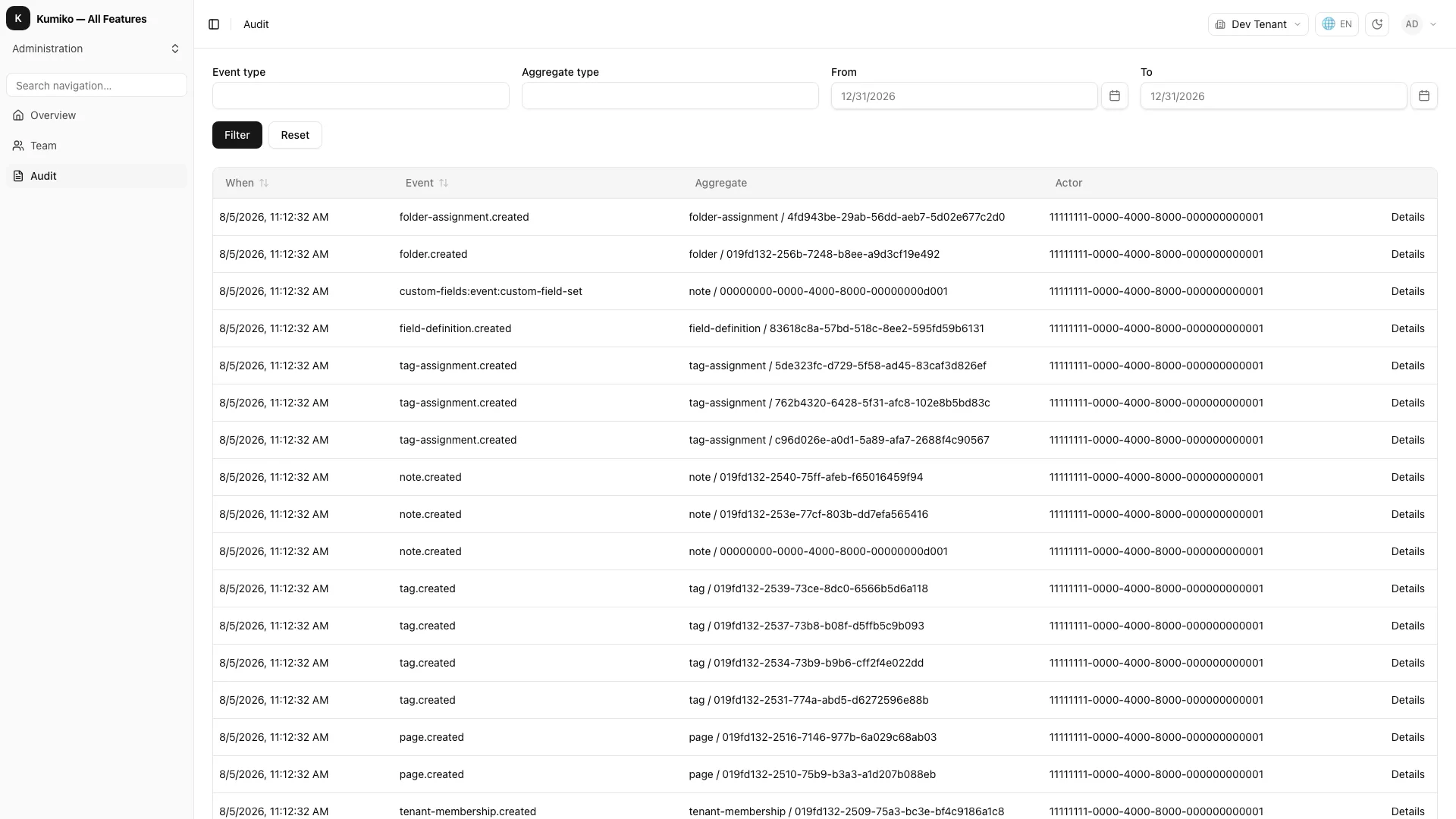
Audit & Compliance by Default

Event store (framework) + audit

shipped

For decision-makers

A complete change history without a separate audit-logging system — for a GDPR access request (Art. 15) or support („what happened on the 12th?”) the system returns the history including who, when and what. Supports audit requirements from SOC-2 or ISO-27001 reviews, but is not a substitute for certification.

For engineers

Event sourcing instead of a parallel audit log — every write produces an event, and the read state is built from those events. The history is the data itself, not an extra system that can drift out of sync.

Docs: audit-security →
Field Encryption & Key Lifecycle

encrypted schema flag, crypto-shredding, secrets, config

shipped · BYOK: in-progress

For decision-makers

Sensitive fields encrypted at rest — salaries, health data and API tokens sit as ciphertext in a DB dump or a leaked backup. GDPR Art. 32 („appropriate technical measures”). Crypto-shredding for Art. 17: delete the key instead of overwriting millions of rows. BYOK (customer vault) is in progress.

For engineers

Encryption as a schema flag, not as application code — a field is marked encrypted at definition time and the framework handles encrypt and decrypt. Erasure by destroying the key instead of a row-by-row overwrite.

Docs: compliance →

Tenant Isolation (TenantDb)

tenant + framework createTenantDb

shipped

For decision-makers

Logical tenant separation — a bug in a tenant filter cannot trivially expose another customer's data, because isolation is enforced at the DB context. Compliance reviews get simpler: isolation is architecture, not a convention in application code.

For engineers

Isolation at the data-access layer, not re-checked in every handler — every request runs tenant-scoped automatically; cross-tenant access is an explicit exception, not the default path.

Docs: identity →

Realtime without extra infrastructure

Framework SSE + Redis Pub/Sub

shipped

For decision-makers

The UI updates live — no manual reloads, no separate Pusher, Ably or Firebase. An estimated €200–500/month of realtime SaaS is avoidable, running over the existing HTTP stack.

For engineers

Server-Sent Events over the existing HTTP stack — no WebSocket cluster, no third party. Affected clients are notified automatically after every write.

Docs: what-you-get →

AI-builder-ready

feature-ast, Designer, ai-patch, ai-foundation

shipped

For decision-makers

Features by prompt, not only by sprint — an LLM writes structured feature code that is validated before it runs, no blind execution of generated code. The Designer acts as a correction layer. Kumiko is positioned for AI-native app development.

For engineers

A declarative feature structure instead of free-form code — because features follow a fixed shape, an LLM can generate them and the framework can validate them before running, instead of trusting blindly.

Docs: patterns →

Tier 2 — Enterprise-grade

Must-haves for B2B SaaS and compliance reviews.

Auth & Sessions

auth-email-password, sessions, auth-mfa

shipped

For decision-makers

Auth flows done — sign-up, login, password reset, invite links for B2B onboarding, TOTP-based 2FA. Sessions are revocable (important when tokens are compromised, or MFA state changes).

For engineers

Passwords hashed, sessions revocable, TOTP MFA with QR enrollment and recovery codes — standard auth flows ready out of the box (Argon2 hashing), no home-grown auth implementation needed.

Docs: identity →

Access Control (RBAC)

Handler access (framework)

shipped

For decision-makers

Permissions declared centrally on handlers — roles are checked before a handler runs, and the UI can bind buttons to allowed actions. Fewer role checks scattered throughout the code.

For engineers

A role check right at each handler definition — authorization is part of the definition, not an ad-hoc check buried in the middle of the code.

Docs: custom-write-handler →

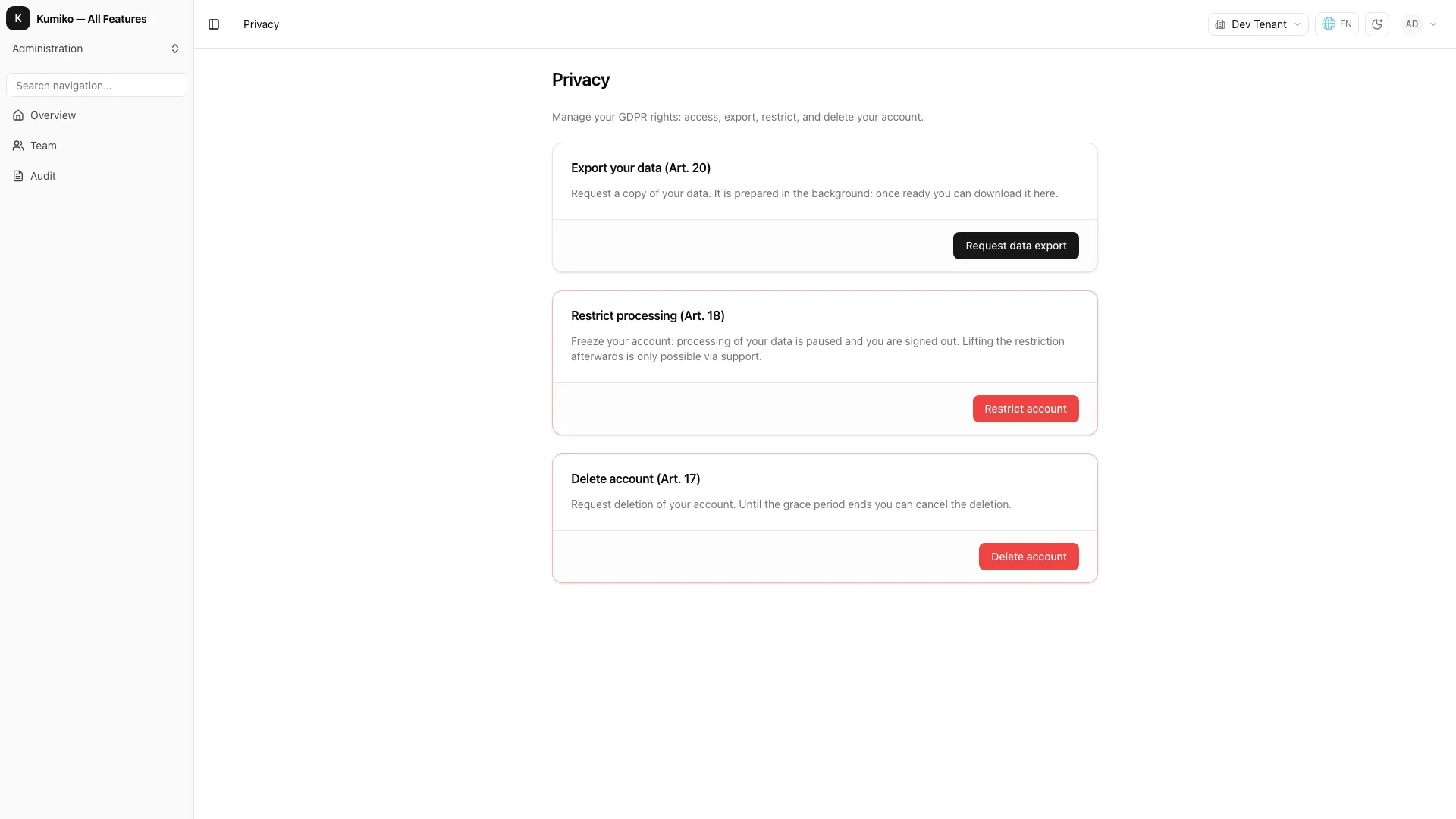
User Data Rights (GDPR Art. 15/17/20)

user-data-rights

shipped

For decision-makers

Access, erasure and portability automatable — a user exports their personal data, and account deletion calls registered hooks. Saves manual legal and ops hours per request, but is not a substitute for legal advice.

For engineers

Export and erasure as registered hooks per feature — each feature declares which data belongs to a person; export and forget then run automatically across all features.

Docs: compliance →

Notifications

delivery + channel-email / channel-in-app / channel-push

shipped

For decision-makers

Email, in-app and push from a single call — no separate notification pipeline per channel. Per-user preferences and a delivery log for support and compliance.

For engineers

One call, multiple channels — the application triggers a notification, the framework fans it out to the enabled channels and logs every delivery attempt.

Docs: notifications →

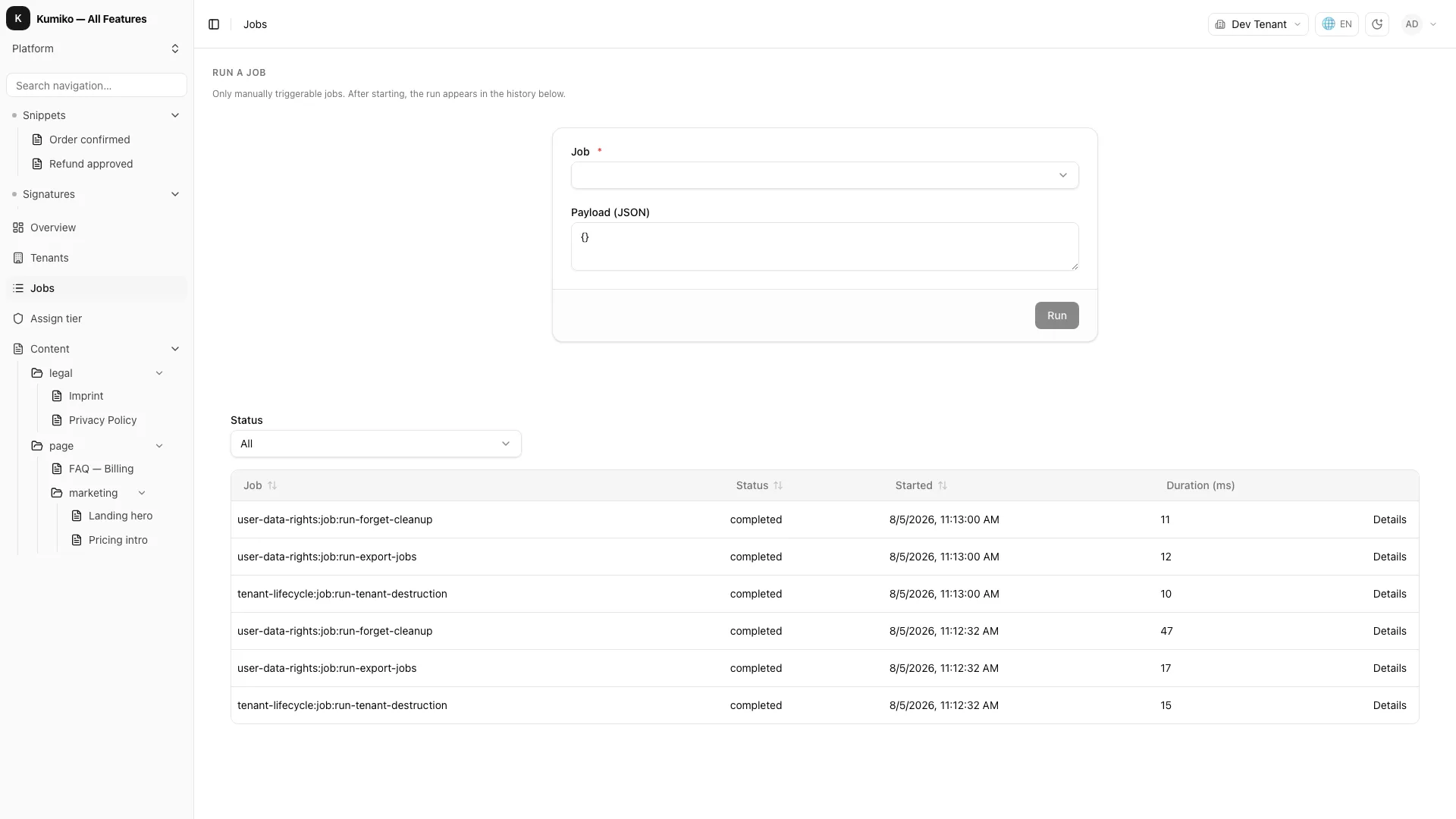
Background Jobs with retry

jobs + BullMQ

shipped

For decision-makers

PDFs, emails and exports run asynchronously — the user doesn't wait 30s for an HTTP response. Retries on transient failures; the operator sees failed runs and can re-trigger them.

For engineers

Proven queue technology (BullMQ on Redis) — no home-grown queue. Every run is logged, failed jobs are visible to the operator and retryable.

Docs: operations →

Rate Limiting

Framework handler option + optional rate-limiting

shipped

For decision-makers

Protection against brute-force and API abuse — configurable limits per user, IP or action. Prevents cost blow-ups from DDoS or frontend bugs, and fair-use per plan is possible.

For engineers

Limits right at the handler definition, not as a separate layer — configurable per route (IP, user, action), Redis-backed, with a standard HTTP 429 response and Retry-After.

Docs: rate-limiting →

Tier 3 — Productivity boosters

The time-to-market argument — weeks instead of months to an MVP.
Show +

Admin UI (schema → screens)

r.screen (framework) + renderer-web widgets

shipped

For decision-makers

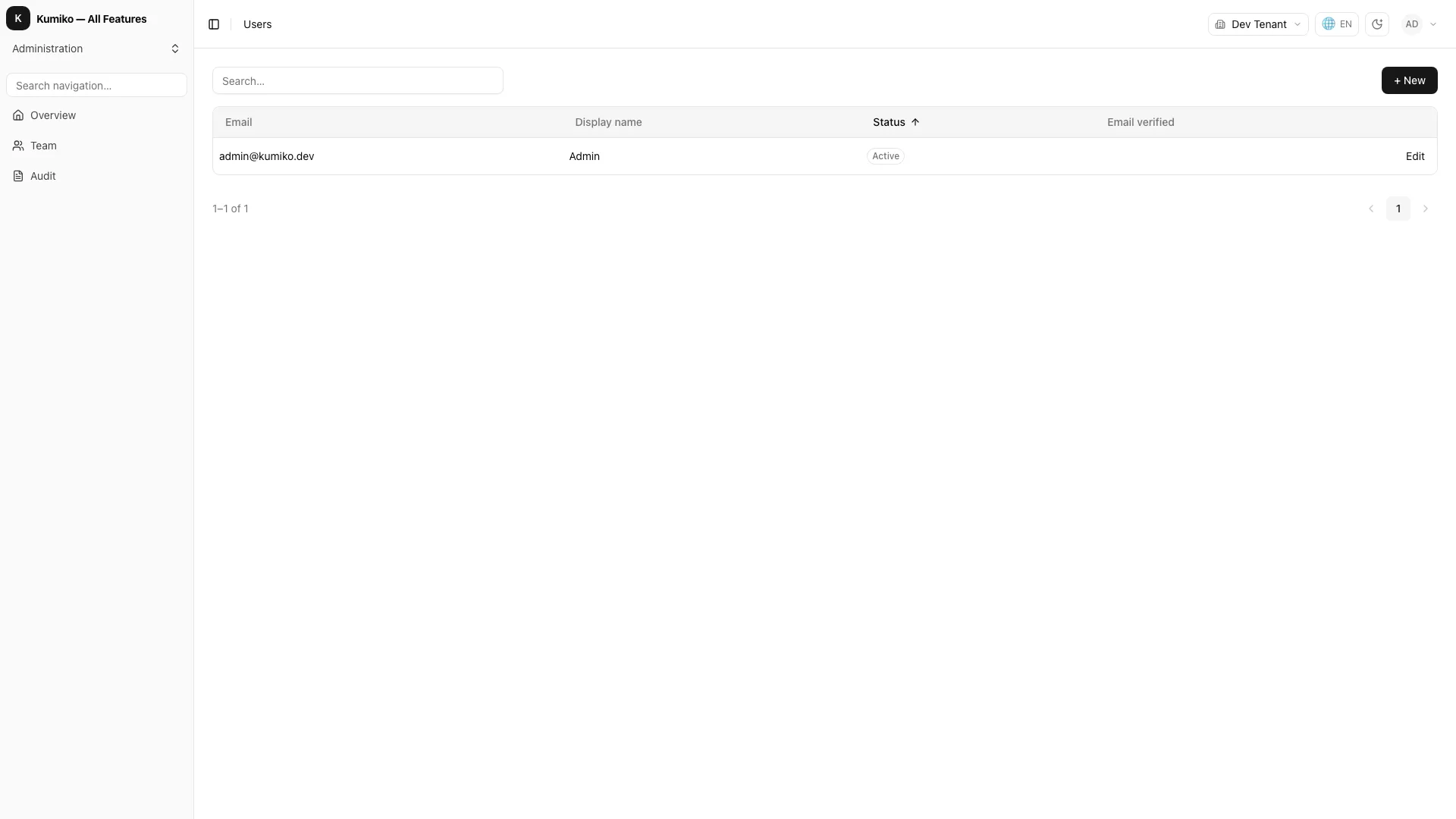
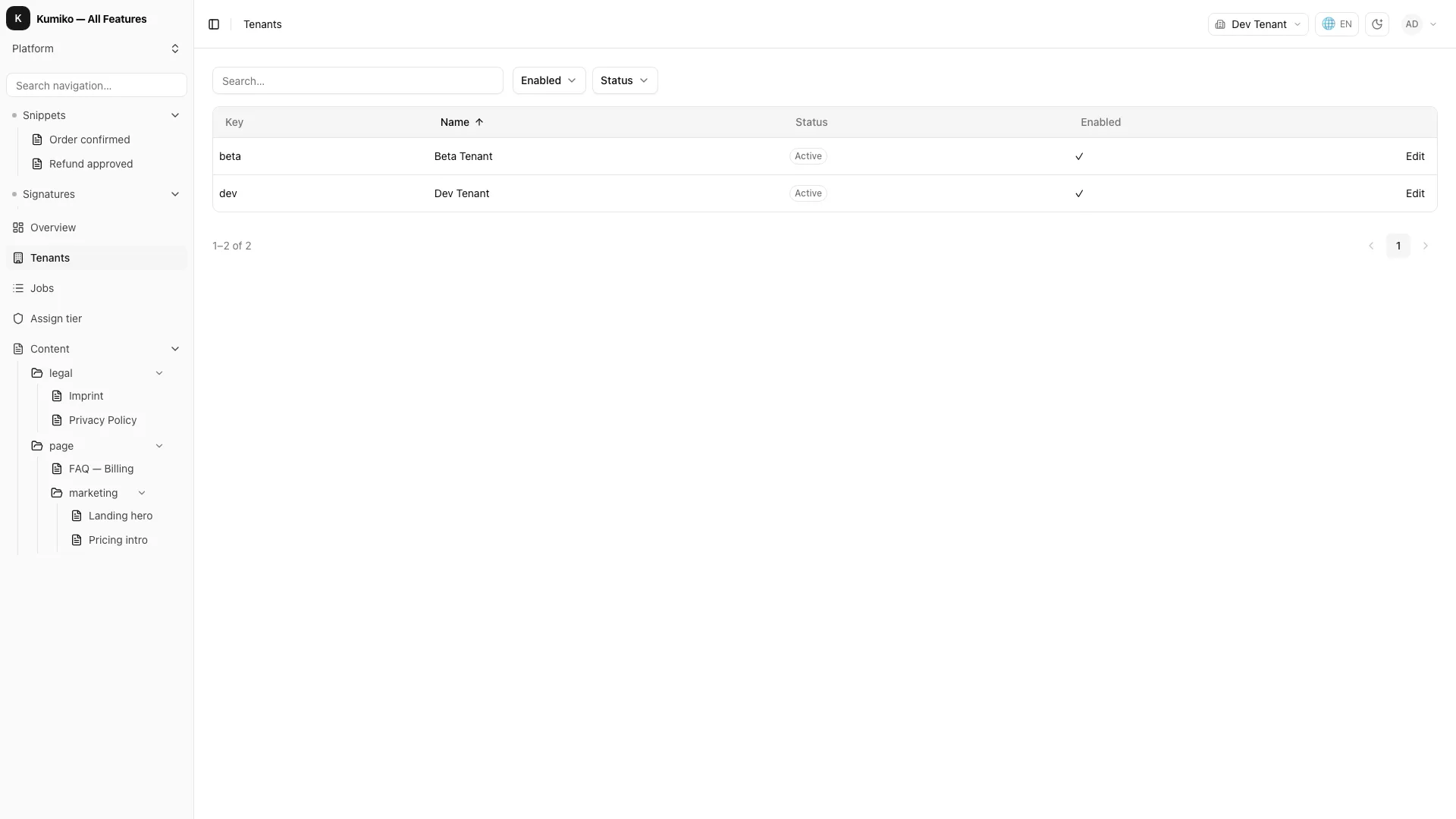
A CRUD interface without writing React from scratch — the entity schema yields a list with filters, pagination and an edit screen. Saves frontend weeks per entity, MVP CRUD is usable immediately.

For engineers

Screens from schema instead of screens by hand — the same definition that describes data and validation automatically drives the table, filters and forms in the admin UI.

Docs: patterns/screen →

Type safety end-to-end

Zod + TypeScript (framework)

shipped

For decision-makers

Fewer runtime surprises — schema changes surface affected call sites directly in the IDE. Faster onboarding, safer refactoring.

For engineers

One schema source for validation and types — runtime checks and compile-time types come from the same definition, no separate OpenAPI layer that can drift out of sync.

Search (Meilisearch)

Pluggable search adapter, Meilisearch as default

shipped

For decision-makers

Full-text search without an ElasticSearch cluster — typo tolerance and facets included. No separate search team for standard use cases.

For engineers

A swappable search adapter instead of a hard-wired search system — Meilisearch is the tenant-scoped default; a different search provider can be plugged in without rebuilding the application.

File Storage (S3/MinIO)

files, file-foundation, files-provider-s3

shipped

For decision-makers

Upload and download with tenant isolation — files are tenant-scoped, presigned URLs allow direct S3 upload. Virus scanning isn't included, but is possible as your own hook.

For engineers

Files tenant-scoped in object storage, with direct upload bypassing the server — presigned URLs, a swappable provider (S3/MinIO), no file server of your own needed.

Docs: files-renderer →

Billing (Stripe / Mollie)

billing-foundation, subscription-stripe, subscription-mollie, tier-engine

shipped

For decision-makers

Subscriptions and webhooks — upgrade flow, payment failures and cancellation as events. Saves weeks of billing integration; Mollie for the EU (SEPA, iDEAL).

For engineers

A swappable payment provider instead of hard-wired Stripe code — webhooks are verified and translated into the same domain events, whether Stripe or Mollie sits behind them. Plan limits are configuration, not special-case code.

Docs: billing-foundation →

Compliance Profiles & Retention

compliance-profiles, data-retention

shipped

For decision-makers

Regional compliance packages — eu-dsgvo, swiss-dsg and de-hr-dsgvo-hgb as ready-made profiles. A retention cron deletes or archives per policy — GDPR Art. 5 and 17 supported operationally.

For engineers

Retention rules as configuration per tenant, not as scattered cron scripts — a profile defines how long which data is kept; deletion and archival run automatically from there.

Docs: compliance →

Headless API Access (PAT)

personal-access-tokens

shipped

For decision-makers

Any external tool that speaks HTTP integrates without custom code — CI, Zapier, a customer's ERP, Alertmanager call your API with a long-lived, revocable Bearer token. No browser login, no SDK, nothing to build on the other end. Scoped per token, revoked instantly if compromised.

For engineers

Tokens resolved before JWT verification, carrying the user's live roles with scoped, fail-closed enforcement at the API boundary — mint, list and revoke are self-service, no admin ticket needed.

Docs: personal-access-tokens →

Tier 4 — Developer experience

Valued by engineers, rarely the primary sale.
Show +

Config & Secrets

config, secrets

shipped

For decision-makers

Configuration per tenant in the database — SMTP, feature flags and API keys without a redeploy. Secrets are encrypted at rest, changes traceable in the event store.

For engineers

Config and secrets per tenant, not global in env variables — changes without a redeploy, secrets stored encrypted, rotation as a built-in job instead of manual intervention.

Docs: config →

SEO / Site Discovery

seo

shipped

For decision-makers

SEO basics automatically — sitemap.xml, robots.txt (optional) and llms.txt for AI crawlers. Faster indexing of public pages.

For engineers

Sitemap and AI-crawler file generated instead of hand-maintained — derived from the application's public pages and kept up to date automatically.

Docs: content-seo →

Ready to try Kumiko?

Read the docs, look at a live demo, or dig into the source.